E-commerce software built around how your business sells
Build storefronts, inventory workflows, order operations, and customer tools that connect cleanly. Augmex works with retailers and commerce teams from discovery through launch and ongoing improvement.
What is e-commerce software development?
E-commerce software development covers the customer storefront and the operational systems behind it. That can include product discovery, checkout, payments, inventory synchronization, delivery scheduling, returns, wholesale ordering, and reporting. Augmex designs and builds these connected workflows for retailers that have outgrown disconnected tools or need a digital sales channel shaped around their business.
Which problems can custom software solve?
- Cart abandonment that drains revenue: Around seventy percent of carts get abandoned. Most teams treat it as a design problem. More often it is backend latency, payment friction, or a missing trust signal at the wrong moment. Faster checkout flow
- Mobile that converts at half the rate of desktop: Most of your traffic is on a phone, yet mobile conversion lags badly. Responsive layouts are not the fix. Mobile-first architecture and a fast checkout are. Mobile-first experience
- Support volume swallowing engineering time: Returns, order-status questions, and post-purchase queries pull hours away from the roadmap. The answer is rarely more agents. It is better self-service systems. Better self-service
- Inventory that drifts out of sync across channels: Selling on Shopify, a marketplace, and your own warehouse at once means a single oversell can lose a customer for good. Real-time sync is an engineering problem, not an ops one. Connected stock data
What does Augmex build for E-commerce teams?
Conversion engineering
We do not redesign buttons. We rebuild checkout flows, cut payment-gateway latency, and instrument every drop-off point so you can see where revenue leaks.
- One-click and guest checkout flows
- Payment-gateway failover logic
- Real-time A/B test infrastructure
- Exit-intent recovery pipelines
Mobile-first commerce stack
Progressive web apps, headless storefronts, and native bridges built by engineers who have shipped for mobile-only markets.
- Progressive Web App storefronts
- Headless CMS integration
- App-like UX without the app-store tax
- Offline browse and cache
Integrated support automation
We connect your helpdesk, live chat, knowledge base, and order management into one flow, so agents see the full customer timeline instead of a stack of tickets.
- Unified customer timeline
- Order-status self-service portal
- AI-assisted response drafting
- Returns automation workflow
How is AI reshaping online retail?
AI is changing how shoppers find products, what they expect from a store, and how support gets handled. The teams that adapt early are pulling ahead on conversion and margin.
Discovery is going conversational
Shoppers increasingly ask in plain language instead of clicking filters. Stores still built around keyword search and faceted navigation lose them before the product page.
Personalization is now the baseline
AI-driven recommendations and dynamic merchandising have become the expectation, not the edge. A generic catalog converts worse against rivals that tailor every visit.
Support is being automated end to end
AI agents now resolve order-status, returns, and sizing questions that used to need a person, cutting ticket volume while answering faster.
Why build an AI MVP before you re-platform?
Rebuilding a whole store around AI is slow and risky. A focused MVP on one funnel, like AI search or recommendations, proves the conversion lift on real traffic before you commit to a migration.
- Test on one journey instead of the whole store
- Measure conversion lift against your current baseline
- Keep the existing storefront running while you learn
- Scale only the use cases that move revenue
Which Augmex services fit this work?
- End-to-End Development: A full squad of engineers, QA, and a PM owning delivery inside your sprint cycle.
- MVP Development: Test a focused commerce idea with a usable first release and a clear path forward.
- Staff Augmentation: One to five engineers added to your team, with real timezone overlap.
- Vested Growth Teaming: We share the risk. Lower upfront cost, upside tied to your growth metrics.
Which Augmex products may be relevant?
- AI Chatbot: Support assistant trained on your products, orders, and policies.
- CRM: Lead management, duplicate detection, and pipeline automation for B2B and B2C.
- BlackBox: Headless AI engine for personalization, recommendations, and inventory intelligence.
What has Augmex delivered in E-commerce?
FYGO case study
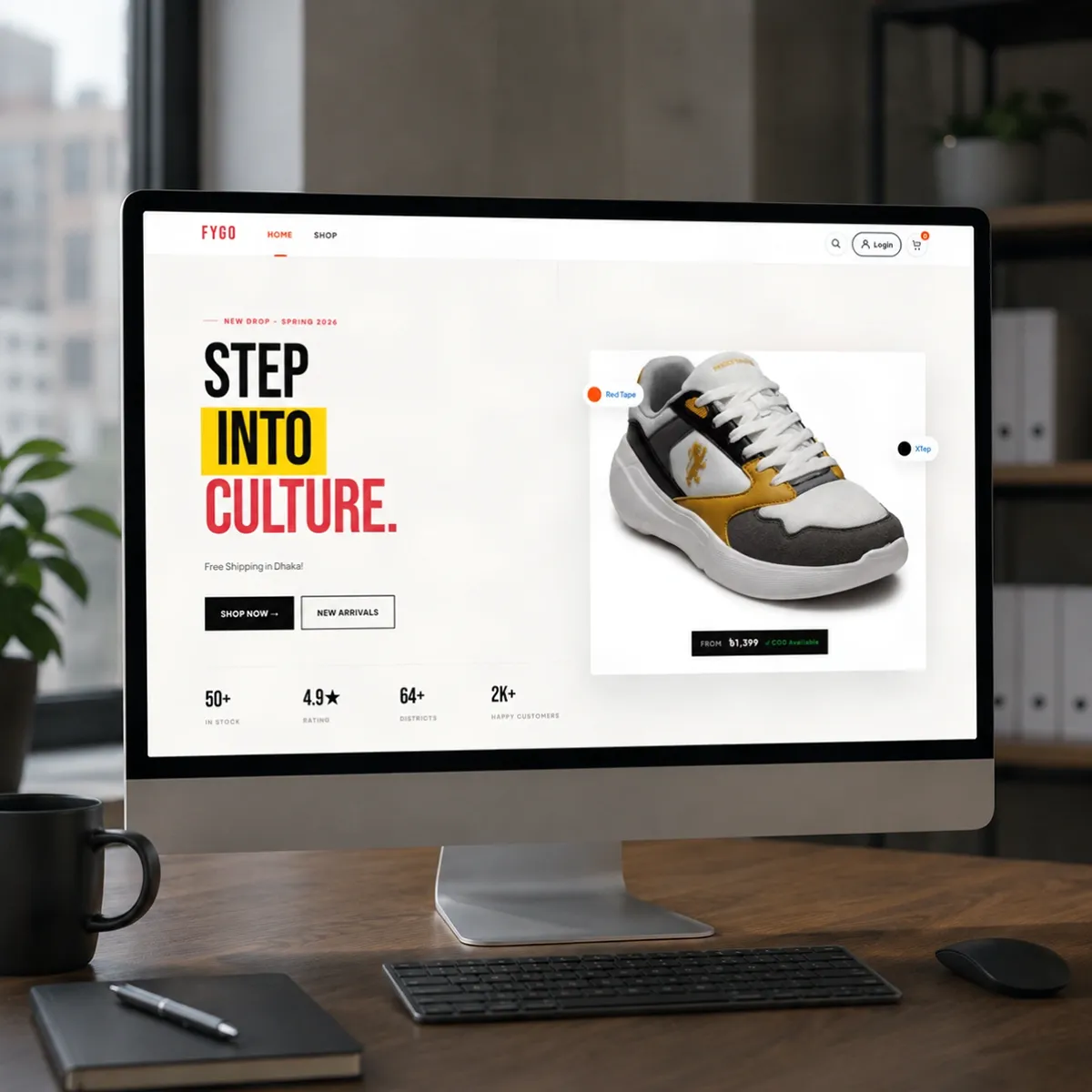
Location: Bangladesh
Result: A WooCommerce fashion storefront connected to a Laravel supply chain, vendor, order, and inventory management system
Challenge: FYGO needed more than a polished online store. The business needed a customer-facing WooCommerce site for fashion retail, plus internal tools to manage vendors, supply chain activity, orders, stock, and operational handoffs without copying data across spreadsheets.
Solution: Augmex designed and developed the WooCommerce website, then built a Laravel operations platform for supply chain, vendor, order, and inventory management. Both systems were synchronized through API integration so storefront activity and back-office operations could stay connected.
Team: Product design, WooCommerce development, Laravel backend engineering, QA, and project management
Timeline: Delivered in 2026
FYGO shows the kind of ecommerce work we like most: the visible store matters, but the real business value comes when orders, inventory, vendors, and supply chain workflows work together behind it.
How does an Augmex e-commerce project work?
- Audit & scope: We map your storefront, checkout, and inventory flow, find the revenue leaks, and hand you a fixed proposal with team composition and timeline. 1-2 weeks
- Team assembly: We pull from a pre-vetted pool of engineers who have shipped commerce before. You interview every candidate before they touch your sprint. 1 week
- Sprint zero: CI/CD, staging environments, access, and ritual alignment. By week four the team is shipping to production. 1 week
- Ship & optimize: Two-week sprints with weekly demos. We instrument everything and A/B test against revenue, not vanity metrics. Ongoing
Related services, case studies, and insights
- How much does an e-commerce MVP cost?: Understand the product and integration decisions that shape an e-commerce MVP budget.
- MVP development services: See how Augmex scopes and builds a focused first version of a digital product.
- FYGO e-commerce case study: Read how Augmex connected a WooCommerce fashion store with Laravel supply chain, vendor, order, and inventory workflows.
Frequently asked questions
- Which e-commerce platform should we build on?
- It depends on where you are headed. Shopify Plus suits fast scaling, Magento handles complex catalog and pricing rules, WooCommerce fits a WordPress stack, and a headless or custom build makes sense for unusual business models. We help you pick based on budget, technical needs, and growth plans rather than pushing one platform.
- How do you actually improve conversion rates?
- We start by instrumenting the funnel so we can see where people drop. From there it is targeted work: faster checkout, fewer payment failures, clearer trust signals, and A/B tests on the changes that matter. The goal is measurable revenue lift, not a redesign for its own sake.
- Can you integrate customer support into our store?
- Yes. We connect live chat, helpdesk software, knowledge bases, and order management so support agents work from one customer view. That cuts response times and pulls routine order-status questions into self-service.
- How long does an e-commerce build take?
- The timeline depends on the storefront, integrations, catalog rules, delivery workflows, and operational scope. We define a focused first release during discovery, then deliver in short stages so you can review working software before the wider platform is complete.
- Do you offer ongoing support and maintenance?
- Yes. Support packages cover monitoring, security updates, performance work, and new features. E-commerce systems need steady attention through peak seasons and platform changes, so most clients keep a small team on after launch.
- Can you build a multi-vendor marketplace?
- We do. That includes vendor onboarding, commission handling, dispute resolution, and the seller and buyer experiences on both sides. Marketplaces carry more moving parts than a single store, so we scope them carefully before committing to a timeline.