Business operations software shaped around your process
Bring HR, payroll, documents, approvals, expenses, procurement, and management reporting into one usable system. Augmex replaces disconnected back-office work with clear digital workflows.

What is business operations software development?
Business operations software development turns recurring internal work into consistent, traceable workflows. It can connect employee records, onboarding, leave, payroll, documents, expenses, purchasing, approvals, and management reporting. Augmex builds these platforms when separate tools and spreadsheets create duplicated entry, unclear ownership, or reporting that no longer keeps up with the business.
Which problems can custom software solve?
- Records are scattered across tools: People lose time finding the current employee, payroll, document, approval, or procurement record when every team stores it differently. Central records
- Approvals have no consistent path: Leave, expenses, purchases, and other requests become difficult to follow when each one moves through email or messages. Visible approvals
- Repeated entry creates avoidable errors: The same information is copied between spreadsheets and systems, which creates mismatches and slows review. Less duplication
- Management reporting arrives late: Leadership needs a current view of people, cost, workload, and operations without assembling it manually each month. Useful reporting
What does Augmex build for Business Operations teams?
HR and payroll operations
Connect employee records, onboarding, leave, performance cycles, allowances, deductions, and payroll review in one controlled workflow.
- Employee records
- Onboarding checklists
- Leave and attendance
- Payroll rules and review
Approvals and document management
Standardize requests and keep the supporting record, version, decision, and responsible person together.
- Configurable approval flows
- Role-based document access
- Version history
- Expense and procurement requests
Operational dashboards
Give leaders a current view of headcount, payroll, leave, approvals, staffing, and other measures supported by the platform data.
- Headcount and staffing
- Payroll and cost views
- Approval status
- Exportable reports
Where can AI reduce back-office effort?
AI can help summarize records, classify requests, draft responses, and retrieve internal information. It should support a defined workflow, respect permissions, and leave important decisions with the right person.
Internal information can be easier to retrieve
A permission-aware assistant can answer questions from approved policies and records while linking people back to the source.
Routine requests can be organized
AI can classify and route common requests, but the workflow still needs clear ownership, review rules, and escalation.
Reports can start with a useful draft
Structured operational data can feed summaries and explanations that a manager reviews before sharing or acting on them.
Why start with one back-office AI task?
Pick a repetitive task with known inputs and a responsible reviewer. A focused MVP reveals the real correction rate, time saved, and permission risks before the tool is exposed to more records.
- Limit the first data sources
- Show where answers come from
- Keep a human approval step
- Track corrections and unresolved requests
Which Augmex services fit this work?
- Back Office Management: Combine process support with the systems needed to run recurring operational work.
- End-to-End Development: Use one product team to map, design, build, test, and release your platform.
- MVP Development: Start with the internal workflows causing the most errors, delay, or duplicated effort.
Which Augmex products may be relevant?
- Workspace Management: Bring work, communication, records, and team activity into a shared workspace.
- Accounting & Inventory: Manage accounting and inventory workflows in a Bangladesh-focused operating system.
- CRM: Structure lead, customer, follow-up, and pipeline operations.
What has Augmex delivered in Business Operations?
Byte Innovations case study
Location: Dhaka, Bangladesh
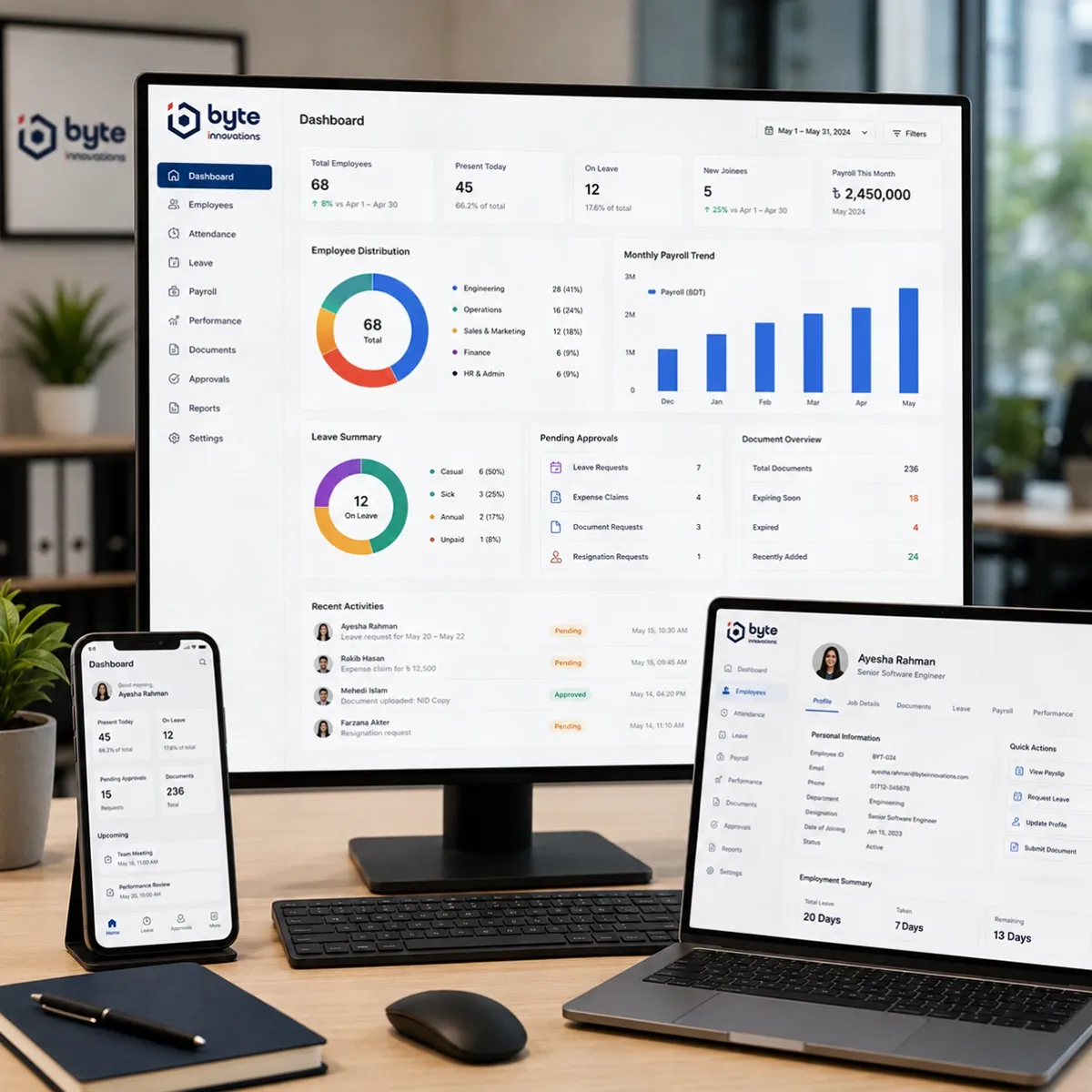
Result: Core HR, payroll, document, approval, and analytics modules delivered in three months
Challenge: As the company grew beyond 30 people, HR, payroll, approvals, and documents were spread across disconnected tools. Payroll errors, scattered records, and inconsistent request handling created operational risk.
Solution: Augmex built a modular back-office platform with employee records, onboarding, leave, performance reviews, payroll rules, document management, standardized approvals, and management analytics.
Team: 5 people: 2 full-stack developers, 1 UX/UI designer, 1 IT strategy consultant, 1 project manager
Timeline: Core modules in 3 months, full system in 5 months
Augmex built a system that our entire team embraced almost immediately. The reduction in errors and processing time has been substantial, and having all our operational data in one place has genuinely changed how we make decisions as a business.
How does an Augmex business operations project work?
- Map the operational work: We follow recurring tasks, records, approvals, exceptions, and reports across the people who perform them. Discovery
- Prioritize the first modules: We choose a release that removes a connected group of problems without trying to replace every tool at once. Release planning
- Build with real users: Employees and managers review working workflows throughout delivery so the product stays practical. Iterative delivery
- Migrate and expand carefully: We plan data migration, access, training, and the next modules around what the team has learned from use. Rollout
Related services, case studies, and insights
- Byte Innovations back-office case study: Read how HR, payroll, documents, approvals, and reporting moved into one platform.
- Back office management: Explore Augmex's blend of operational support, process design, and software.
- Workspace Management: See Augmex's workspace product for connected teams and daily work.
Frequently asked questions
- Which back-office workflow should we digitize first?
- Start where repeated entry, errors, delayed approvals, or reporting effort are highest. The first scope should connect enough of the process to be useful without trying to rebuild the entire back office at once.
- Can custom operations software replace several tools?
- Yes, when the workflows are closely related and one shared record improves the work. We also keep specialist tools when they already work well and integrate them where practical.
- Can you migrate our spreadsheet and system data?
- We can plan migration after reviewing data quality, ownership, duplicates, formats, and retention needs. Migration is tested before launch, and important records are reconciled with the client team.
- How do you control access to HR and payroll records?
- The product can use role-based access, separate permissions for sensitive actions, activity history, and approval boundaries. Exact controls are defined with the people responsible for the data.
- How long does a business operations platform take?
- It depends on the number of modules, rules, integrations, and migration requirements. Byte Innovations received core modules in three months and the full system in five months. We scope your timeline after discovery.