Healthcare software built around care, access, and accountability
Build care management, patient, and operational software with clear permissions, connected workflows, and reliable records. Augmex works with healthcare teams from discovery through delivery and support.

What is healthcare software development?
Healthcare software development turns care and operational workflows into secure digital products. A project may connect scheduling, care plans, staff access, patient communication, reporting, and audit records. Augmex begins by mapping who needs access, what information moves between them, and which technical or regulatory requirements apply to the product. The result is software designed around the real work of providers, staff, patients, and families.
Which problems can custom software solve?
- Patient data that has to be both locked down and usable: Sensitive records must stay protected and still reach the clinicians who need them in seconds. Getting access control, encryption, and audit trails right is non-negotiable and easy to get wrong. Role-based access
- Care that breaks down between providers: When systems do not talk to each other, handovers fall through the gaps. Coordinating care across teams takes integration work, not another portal nobody logs into. Connected care workflows
- Patients who disengage from their own care: Adherence drops when the experience is clunky. Engagement tools only work if they fit the patient's real life, not the org chart of the provider. Clear patient experience
- Regulation that shifts under your feet: Rules change across jurisdictions and audits arrive without much warning. Compliance has to be designed into the system, not patched on before an inspection. Traceable system activity
What does Augmex build for Healthcare teams?
Secure EHR and records platforms
We build and integrate electronic health record systems with the access controls, encryption, and audit logging that healthcare data demands from the first commit.
- HL7 and FHIR integrations
- Role-based access and audit trails
- Encryption at rest and in transit
- Interoperability with existing EHRs
Telemedicine and care coordination
Compliant remote-care platforms and coordination tools that connect care teams around the patient instead of around the software.
- Compliant video and messaging
- Shared care plans across teams
- Scheduling and triage workflows
- Provider and patient portals
Healthcare analytics and compliance
Data pipelines and reporting that turn clinical and operational data into outcomes, with compliance reporting handled rather than improvised.
- Outcome and operational dashboards
- Automated compliance reporting
- De-identified data pipelines
- Regular security assessments
How is AI changing care delivery?
AI is moving into clinical workflows, but healthcare sets a higher bar than most sectors: it has to be accurate, explainable, and compliant before it touches a patient.
Documentation and triage are being automated
Ambient scribing, intake summarization, and first-line triage now handle work that used to consume clinician hours, freeing time for actual care.
Decision support is moving to the point of care
Models surface risks and suggestions inside the workflow, but only earn trust when their reasoning is explainable and every output is logged.
Patient access is becoming conversational
AI front doors handle scheduling, routine questions, and follow-up, which lifts engagement when they are built to escalate safely to a human.
Why pilot an AI healthcare tool before rollout?
A clinical tool has to prove safety and accuracy on a controlled cohort before it goes near a whole system. An MVP lets you validate outcomes and get clinician sign-off without betting the organisation on it.
- Validate accuracy on a controlled patient cohort
- Build audit trails and access controls from day one
- Get clinician sign-off before any wider release
- Expand only once outcomes and compliance hold up
Which Augmex services fit this work?
- End-to-End Development: A full squad that owns a compliant build from architecture to launch.
- Staff Augmentation: Add engineers with healthcare and compliance experience to your team.
- AI-first Software Development: Explore carefully scoped AI features with human review and clear operational controls.
- Mobile App Development: Build reliable mobile access for care workers, providers, patients, or families.
Which Augmex products may be relevant?
- AI Chatbot: Patient-facing assistant for triage, scheduling, and routine questions.
- C-Auditor: Automated auditing to keep systems inspection-ready against shifting rules.
- HRM: Staff scheduling and HR workflows for clinics and care providers.
What has Augmex delivered in Healthcare?
CareAid case study
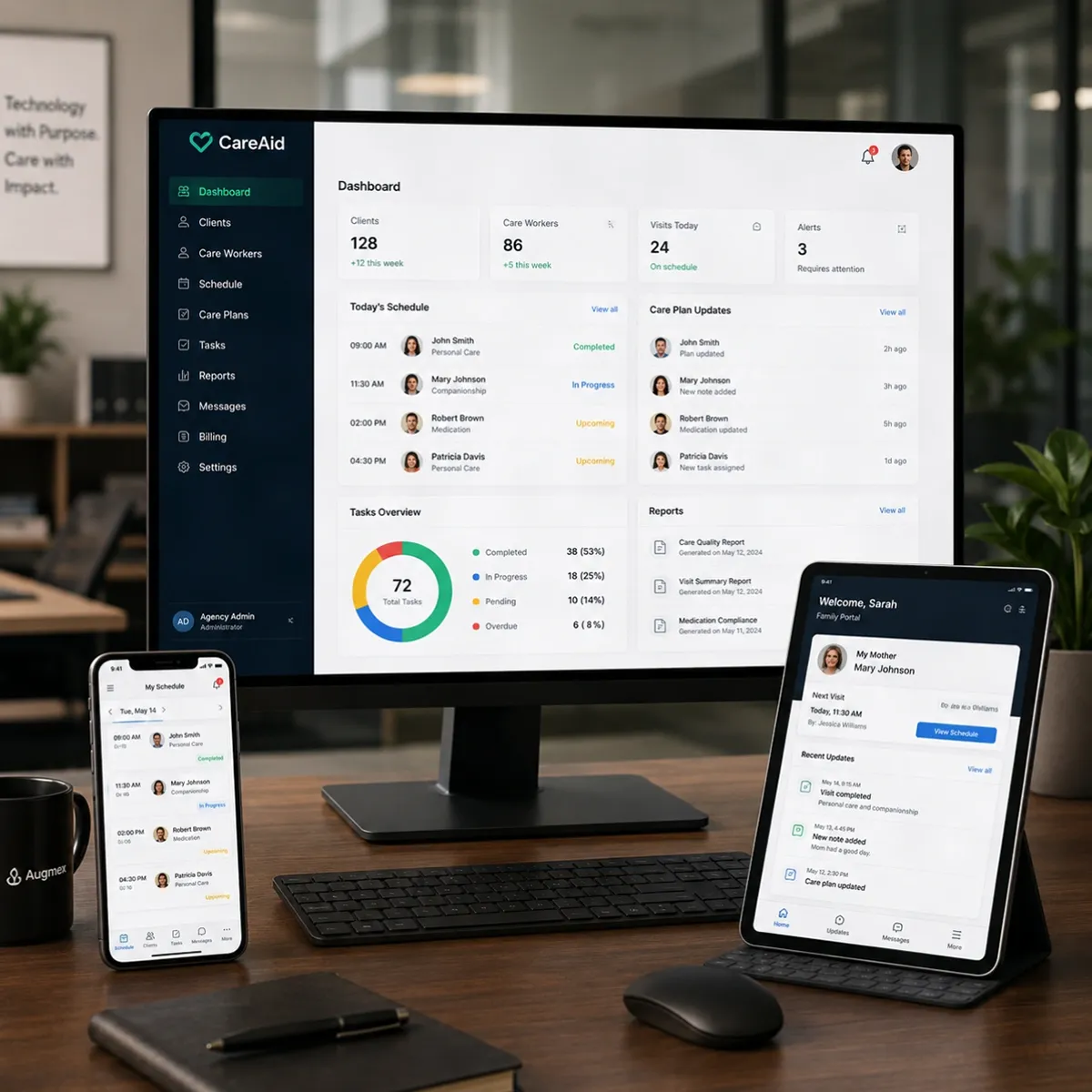
Location: United Kingdom
Result: Three connected product experiences delivered by an eight-person team
Challenge: CareAid needed different experiences for agency managers, care workers, and family members while keeping scheduling, care plans, communication, reporting, access controls, and audit records connected.
Solution: Augmex built a web dashboard for managers, a React Native app for care workers, and a family portal on a shared platform. The MVP was released in three months and the wider platform was completed over the following five months.
Team: 8 people across backend, frontend, mobile, DevOps, and project management
Timeline: MVP in 3 months, full platform in 8 months
Augmex understood our vision from day one. Their team felt like our own employees, not contractors. They helped us navigate complex regulatory requirements while maintaining our aggressive timeline.
How does an Augmex healthcare project work?
- Compliance-first discovery: We map your data flows, integrations, and regulatory obligations before writing code, then scope a build that satisfies them by design. 2-3 weeks
- Team assembly: We match engineers with healthcare and compliance experience to your project. You interview each candidate before they join. 1-2 weeks
- Build with audit trails on: Short sprints with security and logging in place from the start. We deliver working components every two weeks rather than one risky launch. Ongoing
- Operate and maintain: Monitoring, security updates, and compliance maintenance keep the system reliable and inspection-ready as regulations change. Ongoing
Related services, case studies, and insights
- Care management software case study: See how Augmex built connected web and mobile experiences for CareAid.
- Mobile app development: Explore our approach to reliable mobile products for teams working away from a desk.
- End-to-end software development: Bring product design, engineering, QA, DevOps, and delivery into one team.
Frequently asked questions
- How do you handle health data rules such as UK GDPR, NHS DSPT and CQC records?
- Compliance is designed in, not added later. For UK care and health clients that means UK GDPR, the NHS Data Security and Protection Toolkit where NHS data is involved, and records a CQC inspection can rely on. In practice: encryption in transit and at rest, role-based access, full audit trails, and security assessments through the build. For a US client we work to HIPAA on the same footing.
- Can you integrate with our existing EHR and systems?
- Integration depends on the APIs, data formats, permissions, and vendor access available in your current system. We assess those constraints during discovery and design the safest practical way for data to move between the existing platform and the new product.
- How long does a healthcare application take to build?
- It depends on the users, workflows, integrations, security requirements, and validation involved. We define a focused first release during discovery and deliver working components in stages. CareAid, for example, reached an MVP in three months and the wider platform in eight months.
- Do you maintain compliance after launch?
- Yes. Ongoing support covers monitoring, security updates, and compliance maintenance as rules evolve. Healthcare systems cannot be left to drift, so most clients keep a small team on to handle updates and inspections.
- How do you handle healthcare data security in practice?
- We layer it: encryption at rest and in transit, strong authentication, least-privilege access, and regular audits. Security is part of every stage of the build rather than a final gate, which is what keeps sensitive data genuinely protected.
- Can you build for a specific medical specialty?
- We do. We work directly with the clinicians who will use the system to learn the real workflow, then build to that rather than to a generic template. Specialty software lives or dies on those details.