Supply chain software that shows what happens next
Replace scattered calls, messages, and spreadsheets with one operational view. Augmex builds procurement, supplier, order tracking, quality, and delivery workflows around the way your business moves goods.

What is supply chain & procurement software development?
Supply chain and procurement software development turns sourcing, approvals, supplier communication, quality checks, inventory movement, and delivery into a connected workflow. It is useful when standard procurement tools do not reflect the stages, exceptions, or handoffs in a specific business. Augmex maps the real process first, then builds a system that gives each person a clear owner, status, next action, and record of what changed.
Which problems can custom software solve?
- Order updates spread across too many channels: When progress lives in calls, email threads, messaging apps, and spreadsheets, answering a simple status question takes too much coordination. One live order view
- Approvals that wait without an owner: A delayed procurement or quality decision can hold up every stage after it. The system should show who needs to act and what is at risk. Clear ownership
- Supplier progress that is hard to verify: Internal teams need a reliable way to collect supplier updates, documents, milestones, and quality evidence without repeating the same follow-up. Supplier visibility
- Generic tools that miss the real workflow: Specialized sourcing and manufacturing processes often include exceptions that do not fit a standard purchase-order screen. Workflow fit
What does Augmex build for Supply Chain & Procurement teams?
Procurement and approval workflows
Move requests, supplier selection, negotiation, approvals, and documents through a consistent process with visible ownership.
- Configurable approval stages
- Supplier and quotation records
- Document and decision history
- Escalations for delayed actions
Order and production tracking
Give operations and management one view of active orders, current stages, upcoming milestones, and exceptions that need attention.
- Stage-based order tracking
- Production and quality milestones
- Status updates and notifications
- Management pipeline dashboard
Inventory and delivery coordination
Connect receiving, storage, dispatch, and delivery records so teams can follow goods beyond the purchase order.
- Receiving and stock movement
- Dispatch planning
- Delivery status and proof
- Operational reporting
Where can AI support procurement and supply chain teams?
AI is most useful when it helps people review information or spot exceptions. It still needs reliable operational data and a clear human decision point.
Documents can be easier to review
AI can extract fields from quotations, invoices, and shipment documents, then send uncertain items to a person for confirmation.
Exceptions can surface earlier
A system can flag unusual delays, missing updates, or changes in expected milestones when the underlying workflow is structured.
Operational questions can become conversational
Teams can ask for order status or pending actions in plain language when the source data is current and permissions are respected.
Why start with one supply chain AI workflow?
Choose one document, exception, or status workflow where the data already exists. A focused MVP shows whether the output is accurate enough to support the team before AI is added across the process.
- Use one defined data source
- Keep approval with a responsible person
- Measure correction and exception rates
- Expand only after the workflow is trusted
Which Augmex services fit this work?
- End-to-End Development: A complete team to map, design, build, test, and release your operations platform.
- MVP Development: Start with the stages causing the most delay and prove the workflow with real users.
- Staff Augmentation: Add engineering capacity to an existing supply chain or operations product team.
Which Augmex products may be relevant?
- Accounting & Inventory: Connect inventory activity with purchasing, costing, and financial records.
- CRM: Keep supplier, partner, and customer communication connected to the wider workflow.
What has Augmex delivered in Supply Chain & Procurement?
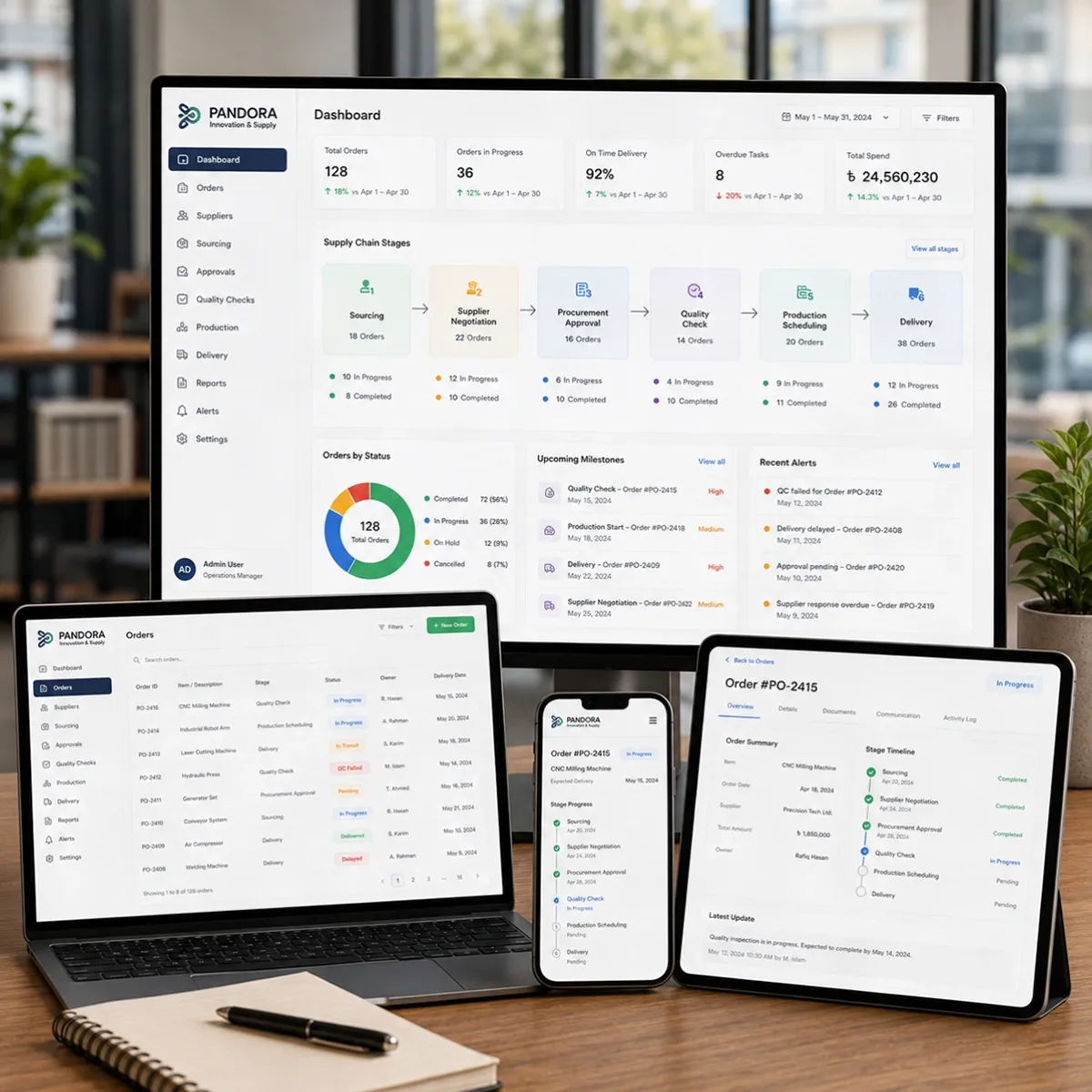
PANDORA Innovation & Supply case study
Location: Bangladesh
Result: Six supply chain stages connected in one system, with core tracking modules live in eight weeks
Challenge: Specialized machinery orders moved through vendors, internal approvals, quality checks, and team handoffs. Updates were scattered across calls, email, and spreadsheets, so order status and delayed actions were difficult to see.
Solution: Augmex mapped PANDORA's real process and built one platform covering sourcing, supplier negotiation, procurement approval, quality checks, production scheduling, and delivery. Each stage received an owner, status, and escalation path.
Team: 4 people: 2 full-stack developers, 1 business analyst, 1 project manager
Timeline: Core modules in 8 weeks, full system in 5 months
Augmex invested the time to truly understand how we operate and translated that into software that actually works for us. The reduction in manual coordination has freed up significant time for our team.
How does an Augmex supply chain & procurement project work?
- Map the real workflow: We follow an order from request to delivery, including approvals, exceptions, documents, and handoffs. Discovery
- Choose the first useful scope: We prioritize the stages where visibility or coordination will make the clearest difference. Release planning
- Build with operating teams: Buyers, managers, and other users review working software throughout short delivery cycles. Iterative delivery
- Connect and improve: After the core workflow is stable, we add integrations, reporting, automation, and further stages where useful. Ongoing
Related services, case studies, and insights
- PANDORA supply chain case study: Read the full story behind the six-stage order tracking platform.
- End-to-end software development: See how Augmex takes operational software from discovery to production.
- Retail software development: Explore connected inventory, sales, and decision-support systems for retailers.
Frequently asked questions
- Can you replace our procurement spreadsheets?
- Yes, but we first identify what those spreadsheets are doing for the team. The new system should preserve useful flexibility while adding ownership, validation, history, and a shared operational view.
- Can suppliers update orders directly?
- A supplier portal can provide controlled access to milestones, documents, quality evidence, or delivery updates. Permissions are designed so each supplier only sees the records relevant to them.
- Can the platform connect to accounting or inventory software?
- It can when the existing product provides suitable APIs, exports, or database access. We assess the available interfaces and define the data ownership and synchronization rules before implementation.
- How long does custom supply chain software take?
- It depends on the number of stages, user roles, integrations, and exceptions. PANDORA's core tracking modules went live in eight weeks and the full system was delivered in five months. Your timeline is scoped after discovery.
- Should we buy a standard system or build custom software?
- A standard product is usually better when your process fits its model. Custom development makes sense when the workflow itself is important to how you compete, or when generic tools create too much manual work around their gaps.